
The business question What is our application roadmap? shows when applications are planned to be implemented and when they will no longer provide support to the business.
A robust application lifecycle management includes versioning and planning for successor applications to ensure that IT continues to support critical business areas. Look for applications that are approaching their end-of-life but have no successor applications planned. This business question helps you to identify gaps in application support and take corrective action for applications that are at risk.
Navigate to What is our application roadmap?
Use the method that is most convenient for you:
- In the left navigation panel, enter What is our application roadmap? in the Search Navigation field.
- In the left navigation panel, click Home. In the content area, go to the Business Questions page and click the tile for What is our application roadmap?
- In the left navigation panel, expand the sections Business Questions and Roadmapping and click What is our application roadmap?
What information is displayed in What is our application roadmap?

The visualization is a Gantt chart that shows the lifecycles of all applications in the repository. Here's how to interpret the information:
- The rows show
 applications
- Columns show a checkmark if an application's Strategic Application attribute is set to Yes. The Object State column indicates if an application is
 active,
 plan, or
 retired.
- The timeline shows a green bar visualizing the active period (start date - end date) of the application. If an application lifecycle is defined, lifecycle phases will be displayed in a multi-colored bar above the green bar:
 Plan
 Pilot
 Production
 Sunset
 Retired
- The blue vertical line indicates the current date.
- The relationships between predecessor and successor applications as well as predecessor and successor contracts are displayed as black lines. If an application has a successor application defined, a black line will begin at the end of the predecessor application's lifecycle and point to the start of the successor application lifecycle. Point to the black line to view a tooltip showing the predecessor application, successor application, and end date of the predecessor application.
How can I edit the data in What is our application roadmap?
If you have the relevant access permissions, you can edit the applications in this business question.
Click  Edit > Edit Applications. In the Applications data workbench. Use the features of the data workbench to slice-and-dice your data to focus on data and do the analyses you are interested in. You can edit the following for an application.
- Object State: The object state describes the use of the application in the real world. This can be understood as the operational status of the application.
- Start Date and End Date: The start and end date captures the period when the application is actively running and can be used in the company. This is also when the Object State attribute should be specified as Active. Click the calendar icon to select the date or enter the date in the date format Month/Day/Year. For example: 4/30/2023
- Release Status: This is an approval status and typically indicates the level of quality of the information about the application.
- Strategic Application: Select the checkbox if the application is strategic for the company.
- Successor: The next application that will follow this application version.
You can  navigate to the content area of an application and go to Overview > Application Lifecycle to specify the lifecycle statuses.
What data is required for What is our application roadmap?
Business question: What is our application roadmap?
Purpose: Understand when applications are planned to be implemented and when they will no longer provide support to the business.
DATA REQUIREMENTS
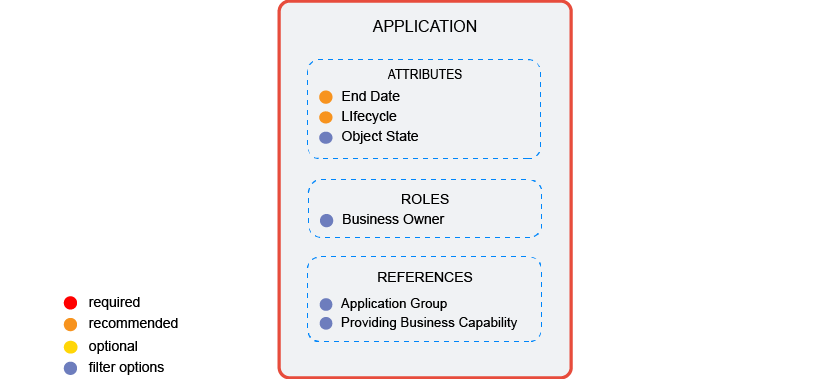
Capture the data necessary for the business question. Applications must be in the repository and well documented. Try to capture as much information as possible about the applications because complete data considerably improves the results of the business question and your ability to focus on the data that is most important to you.
- Specify the application's attributes including End Date.
- Document the application_apo's lifecycle.
Improve the data and correct data quality issues. Go to the business question's Data Quality > Data Completeness. This visualization helps you to assess whether sufficient data is available to produce meaningful and reliable results for the business question.
- Go to Pending Issues to resolve data quality issues and improve the data that the business question is based on. Only the first 5000 issues are displayed.
- Go to the Data Source page to understand the underlying data relevant to the business question. The data source is a list report and cannot be edited.