The business question Where do we have SLA violations? examines the service level agreements for business services and their support services and compares the indicators of the SLAs. The visualization highlights where support services do not provide enough support to the business service and where violations may be occurring with service level agreements. This business question helps you to understand the business service demand and the support service supply chain, and identify risk due to inconsistencies in the supply chain.
The license package IT Transformation Server - Enterprise is required to work with this business question. The use case Service Portfolio Management must be activated.
Navigate to Where do we have SLA violations?
Use the method that is most convenient for you:
- In the left navigation panel, enter Where do we have SLA violations? in the Search Navigation field.
- In the left navigation panel, click Home. In the content area, go to the Business Questions page and click the tile for Where do we have SLA violations?
- In the left navigation panel, expand the sections Business Questions and Risk and click Where do we have SLA violations?
What information is displayed in Where do we have SLA violations?
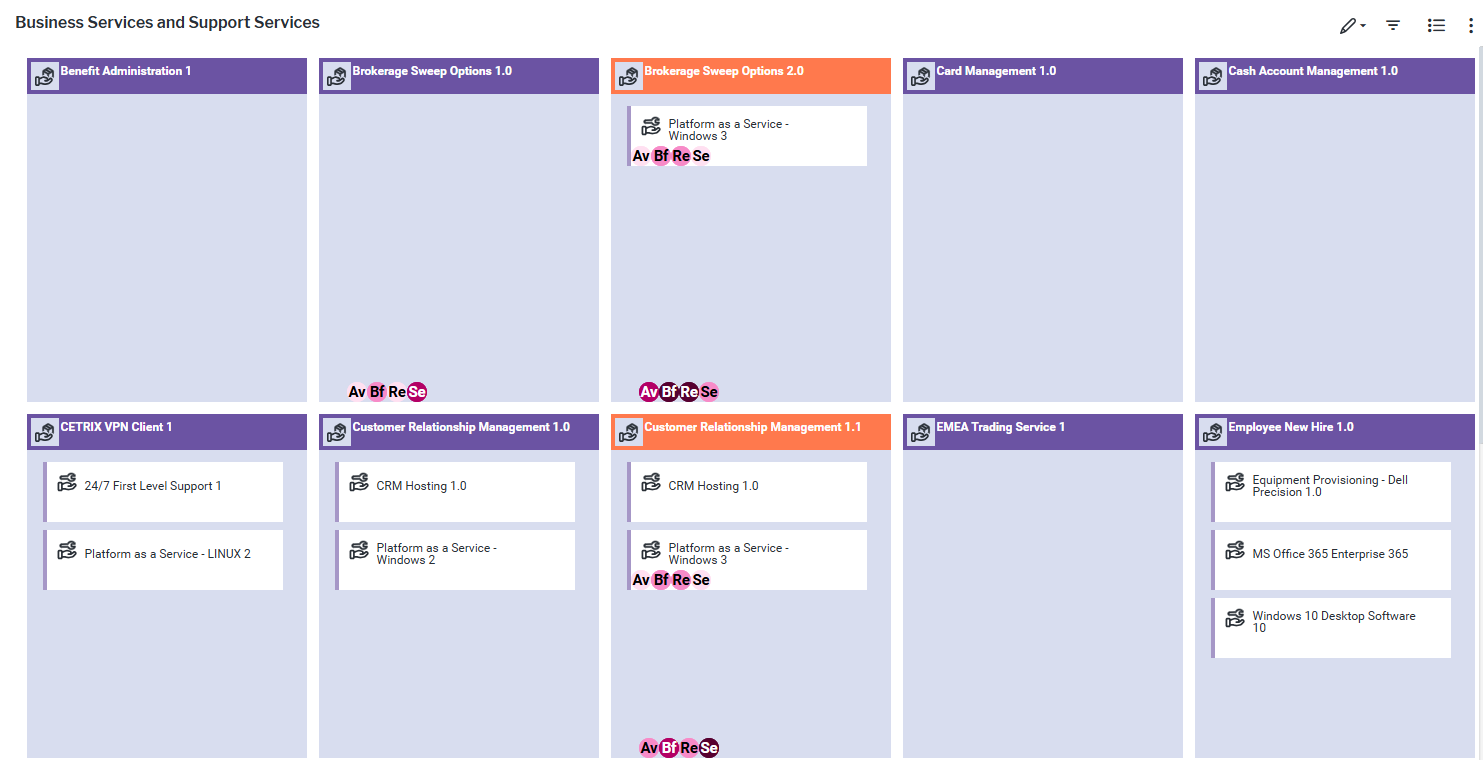
A nested matrix shows the business services, their support services and the alignment of their service level agreements (SLAs). Here's how to interpret the information:
- Business services
 are shown in the large boxes.
 - Support services
 are nested in the business service they provide.
 - Colored symbols are displayed for business services and support services. The indicators are specified for the service level agreements of the business service and the support service. The following indicators are visualized:
- AV: The Availability indicator evaluates the amount of time that the service is available for use by consumers during the defined uptime hours.
- BF: The Backup Frequency indicator evaluates the frequency guaranteed by the service provider to back up the service data.
- RE: The Responsiveness indicator evaluates the average time that it takes for an issue to be answered by the service desk of the service provider.
- SE: The Security Breach Alert indicator evaluates the number of hours that the service provider has to alert its customers who consume the service of a security breach of the organization's data.
- The indicator icons are colored based on how high the value is. Point to an indicator to see its name and value. Click the
 3-dots button > Show Legend to understand the color coding.
 - The business service is colored orange if a service level violation exists. A service level agreement violation is visualized if at least one of the indicators for the support service's SLA does not align with the indicators specified for the business service's SLA. This indicates that the support service is not adequately supporting the business service based on the service level agreement due to one of the following indicators: Availability, Backup Frequency, Responsiveness, or Security Breach Alert.
What data is required for Where do we have SLA violations?
Business service data must be in repository as well as support service data to have meaningful results for this business question. The following data is required for this business question:
- Service level agreement (SLA)
- Availability indicator: The amount of time that the service is available for use by consumers during the defined uptime hours.
- Backup Frequency indicator: The frequency guaranteed by the service provider to back up the service data.
- Responsiveness indicator: The average time that it takes for an issue to be answered by the service desk of the service provider.
- Security Breach Alert indicator: The number of hours that the service provider has to alert its customers who consume the service of a security breach of the organization's data.
Go to the Data Quality page. The Data Completeness view indicates the data that is recommended for meaningful results to the business question. Scroll to the Pending Issues view to resolve the issues and to ensure that the data is complete. Only the first 5000 issues are displayed.
Go to the Data Source page to review the service data that is used to answer the business question. The data source is a list report and cannot be edited.