
The IT Transformation Server - FastLane license package in Alfabet provides access to classes and functionality so that you can capture and analyze the most important facets of your IT architecture. The use cases included with the license package support Application Portfolio Management (APM) and Technology Portfolio Management (TPM) practices so that IT leaders can manage and govern the applications and technologies used in the organization.
In a rapidly evolving digital landscape, Alfabet provides a structured approach to continuously evaluate, rationalize, and optimize the application ecosystem. Key stakeholders can prioritize applications based on their value, functionality, and relevance. This delivers tangible benefits across the enterprise. It reduces costs by consolidating redundant applications, enhances agility through a leaner portfolio, and lowers IT risk by minimizing complexity. Alfabet also empowers better decision-making with data-driven insights into application performance, usage, and costs, while streamlining compliance efforts and fostering stronger collaboration between business and IT teams. Ultimately, Alfabet transforms application governance into a proactive, value-driven process that supports innovation and operational excellence and ensures that investments in IT support long-term business strategy.
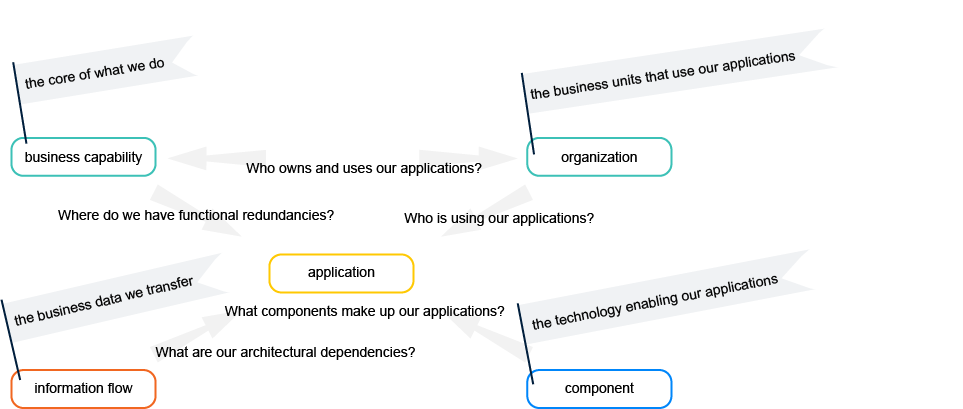
The use cases included with the license package facilitate a comprehensive view of the application portfolio that includes the business capabilities each application supports, the flow of information across systems, and the underlying technologies that form the IT infrastructure. Through this integrated approach, Alfabet also helps you to track and manage transformation initiatives—such as modernization projects or cloud migrations. By strategically aligning applications, technologies, and initiatives with core business objectives, your enterprise can streamline operations, enhance agility, and empower smarter decision-making that fuels sustainable growth.
Where to begin
 |
Capture your IT inventory. This includes documenting the assets in your business architecture, application architecture, information architecture, technology architecture, and project portfolio. |
 |
Assess your company's business capabilities. Identify and prioritize the business capabilities that are most critical to your business. Understand which applications and projects contribute to the cost and performance of each part of the business. Assess the impact of your application landscape on business capabilities to understand how technology enables your operations. |
 |
Assess your application portfolio. Understand the ownership of applications to ensure effective governance of the IT. Identify which business processes rely most heavily on IT support to prioritize resources and ensure critical operations are well-served. Analyze operational expenditure (OPEX) across the portfolio to uncover cost drivers and opportunities for optimization. Define a rationalization strategy to reduce redundancy, eliminate underperforming applications, and improve overall efficiency. Evaluate which applications are suitable for cloud migration based on scalability, cost, and business value. Assess the security of your application data to safeguard sensitive information and maintain compliance. |
 |
Evaluate the information portfolio. Understand how data flows through your application landscape and how it supports core business capabilities. Identify architecture dependencies created by information exchanges between applications. Assess the impact of application and server outages on business capabilities to strengthen resilience planning. Document where sensitive data is used, stored, and transferred to ensure compliance with data protection regulations and to mitigate security risks. |
 |
Analyze the technology portfolio. Identify the vendors supplying each component to maintain transparency in sourcing and support. Document where your applications are deployed—whether on physical servers, virtual machines, or cloud environments. Analyze your standards catalog to ensure technologies align with architectural principles and compliance requirements. Review the ownership of each technology asset to clarify accountability and streamline lifecycle management. |
 |
Manage the project portfolio. Understand the scope of change across your enterprise. Identify which IT architecture is impacted by each project to assess dependencies, risks, and alignment with business goals. Evaluate the cost and effectiveness of your projects to guide investment decisions. Highlight high-cost initiatives to monitor budget impact, and identify which projects deliver measurable value to the business. |
 |
Plan the evolution of your IT landscape. Identify your technical debt—the outdated technologies and applications that are not effectively supporting your business. Define your application roadmap to outline how your application portfolio will evolve over time, including successor technologies. Align this with your technology roadmap to chart the future IT infrastructure. |
Prerequisites
The license package IT Transformation Server - FastLane provides the capabilities for basic data management and is required to work with the following use cases, classes, and business questions:
- The use case Business Capability Management must be activated to work with the class stereotype Business Capability and the following business questions:
- What should we be focusing on?
- What are our cost drivers?
- What is our application landscape?
- What is our target architecture?
- How will IT failure impact our business?
- The use case Application Portfolio Governance must be activated to work with the classes Application, Application Group, Organization, Operational Business Support, and Business Process and the following business questions:
- What is our application portfolio?
- Who owns which applications?
- Which business process areas require the most IT support?
- What is our OPEX distribution?
- What is the status of our rationalization plan?
- What are our cloud focus areas?
- What is our cloud migration strategy?
- The use cases Information Portfolio Governance and Basic Data Management must be activated to work with the classes Information Flow, Business Object Category, and Business Object. The use cases Information Portfolio Governance and Advanced Data Management must be activated to work with the classes Information Flow, Business Object Category, Business Object, Business Data. Learn more about data management use cases for the information architecture. The following business questionsare available:
- What are our architecture dependencies?
- Where do we use sensitive data?
- The use case Technology Portfolio Governance must be activated to work with the classes Component, Local Component, Location, Physical Server, Virtual Server, IT Capability, and Vendor and the following business questions:
- Who are our vendors?
- Where are our applications deployed?
- What is our standards catalog?
- The use case Deployment Management must be activated to work with the class Deployment.
- The use case Project Portfolio Governance must be activated to work with the classes Project and Project Group and the following business questions:
- What is the status of our project portfolio?
- What are our most important projects?
- What is our CAPEX distribution?
- The use case Roadmapping must be activated to work with following business questions:
- What is our technical debt?
- What is our application roadmap?
Data management use cases for information architecture
Alfabet provides two different scenarios to capture data flows in the information architecture. The Basic Data Management use case is an easy, less complex approach where data is managed for business objects. The Advanced Data Management use case adds another layer of detail by adding business data to the information hierarchy as instantiations of business objects. The use cases are part of your IT Transformation Server license and your solution designer can activate the relevant use case scope for your solution configuration.
Basic Data Management
- The use case Basic Data Management is activated per default. In this case, the transfer of data is captured via business objects.
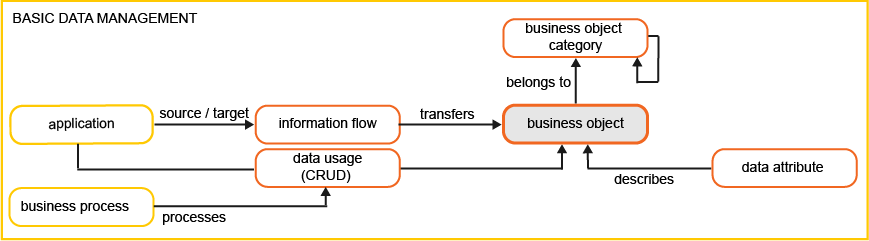
- Business objects are at the leaf level of the hierarchy Business Object Category > Business Object.
- Data workbenches will be available in the navigation panel for Business Object Categories and Business Objects.
- Information flows transfer business objects between applications. A Transferred Business Objects view is available in the information flow content area where transferred data can be captured from the perspective of the incoming or outgoing information flow.
- Data usage and CRUD (Create, Read, Update, Delete) operations are captured for the business object.
- The business questions Where do we use sensitive data? and Where is our data processed? visualize business objects.
Advanced Data Management:
- The use case Advanced Data Management adds business data as a child of business object. The business object represents an entity such as a customer, invoice, or order. It is defined by a set of attributes (e.g., Name, Phone Number). Business objects are used and exchanged in business processes. A business data is the concrete, logical instantiation of a business object.
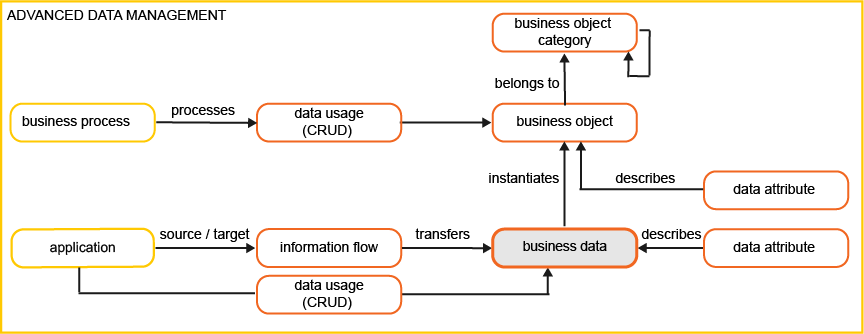
- Business data are at the leaf level of the hierarchy Business Object Category > Business Object > Business Data.
- Data workbenches are available in the navigation panel for Business Object Categories, Business Objects, and Business Data.
- Information flows transfer business data between applications. A Transferred Business Data view is available in the information flow content area where transferred data can be captured from the perspective of the incoming or outgoing information flow.
- Data usage and CRUD (Create, Read, Update, Delete) operations are captured for the business data.
- A Business Data data workbench is available in the business object content area to capture the business data that instantiates a business object. A Business Data Governance view shows all business data associated with the business object, the compliance of the data, and analysis of its attributes.
- The business questions Where do we use sensitive data? and Where is our data processed? visualize business data.