
Bizzdesign logo
  • Contact us
    Alfabet Support Hopex Support Horizzon Support Unify Support
  • Bizzdesign Community
  • Bizzdesign University
  • Bizzdesign
 
  1. Alfabet help
  2. IT Transformation Server - FastLane
  3. Understand application deployment
  • Begin with your IT transformation
  • Capture your IT architecture
    • Document the business architecture
      • Capture business capability data
      • Capture business process data
      • Capture location data
      • Capture organization data
      • Capture vendor data
    • Document the application and information portfolio
      • Capture the information architecture - Basic Data Management
      • Capture application data
      • Capture application group data
      • Capture information flow data
      • Capture business objects
      • Capture business object categories
      • Capture the information architecture - Advanced Data Management
      • Capture application data
      • Capture application group data
      • Capture information flow data
      • Capture business objects
      • Capture business object categories
    • Document the technology portfolio
      • Capture IT capability data
      • Capture component data
      • Capture component group data
      • Capture component category data
      • Capture physical server data
      • Capture virtual server data
    • Document the project portfolio
      • Capture project data
      • Capture project group data
    • Analyze "Who is responsible for our assets?"
      • Find assets with no responsibilities defined
      • Find assets that a user is responsible for
      • Identify the users and organizations responsible for an asset
      • Define responsibility for an asset
  • Manage your business capabilities
    • Analyze: What should we be focusing on?
      • Identify business capabilities requiring attention
      • Understand the current application support
      • Understand the future application support
      • Understand which organizations own critical business capabilities
      • Identify business capabilities used by a specific organization
    • Analyze: What are our cost drivers?
      • Identify current application costs
      • Review the most expensive business capabilities
      • Identify applications to rationalize
      • Identify project costs
    • Analyze: What is our application landscape?
      • Identify the most important applications
      • Understand future applications
      • Identify risks to business support
      • Identify complexity
    • What is our target architecture?
      • Understand the support for business capabilities
      • Understand applications providing business support
      • Understand planned business support
      • Identify applications recommended for the target architecture
      • Identify risk due to technical obsolescence
    • How will IT failure impact our business?
      • Understand the impact of a local shut-down
      • Understand the impact of application failure
      • Review the IT support of a business capability
      • Review the IT support of a business capability
  • Manage the application portfolio
    • Analyze: What is our application portfolio?
      • Identify all active applications
      • Identify applications owned by an organization
      • Identify all applications supporting a business capability
      • Identify strategic applications
      • Identify the most expensive applications
      • Identify applications to sundown
      • Understand who is responsible for an application
    • Analyze: Who owns which applications?
      • Improve the data regarding application ownership
      • Understand which organizations own applications supporting a business capability
      • Understand which organizations own active applications
    • Analyze: Which business areas require the most IT support?
      • Identify at-risk business processes
      • Identify application support
      • Identify technological risk
    • Analyze: What is our OPEX distribution?
      • Identify cost savings through application rationalization
    • Analyze: What is the status of our rationalization plan?
      • Understand cost savings due to rationalization
      • Analyze trends in rationalization activity
      • Understand planned applications
    • Analyze: What are our cloud focus areas?
      • Indentify candidates for migration
      • Identify candidates for sundowning
      • Review costs of migration candidates
    • Analyze: What is our cloud migration strategy?
      • Identify applications to migrate
      • Identify applications to retire
      • Identify the business capabilities impacted by cloud migration
  • Manage the information portfolio
    • Analyze: What are our architectural dependencies?
      • Identify applications are potentially obsolete
      • Understand impact of migration to data flows
      • Identify planned information flows
    • Analyze: Where do we use sensitive data?
      • Identify redundant use of data
      • Understand where personal data is used
      • Identify GDPR-relevant data
  • Manage the technology portfolio
    • Analyze: Who are our vendors?
      • Identify vendors with critical components
      • Identify vendors important to the business
      • Identify vendors important to the technology infrastructure
    • Analyze: Where are our applications deployed?
      • Understand application deployment
    • Analyze: What is our standards catalog?
      • Show components on first-level IT capabilities
      • Identify IT capabilities with non-standard components
      • Understand the applications using a component
      • Understand who is responsible for a component
  • Design the project portfolio
    • Analyze: What is the status of our project portfolio?
      • Identify projects at risk
      • Identify projects with dependencies
      • Change a project's milestones
    • Analyze: What are our most important projects?
      • Identify risk due to project complexity
      • Identify business impact due to project failure
      • Understand project risk to the IT infrastructure
      • Identify the most expensive projects
    • Analyze: What is our CAPEX distribution?
  • Roadmapping
    • Analyze: What is our technical debt?
      • Identify applications that are at risk
      • Identify IT capabilities at risk
      • Identify technology migration needs
      • Identify business capabilities at risk
    • Analyze: What is our application roadmap?
      • Review successor applications
      • Change an application lifecycle
      • Understand changes to application support

Which applications are deployed at a location?

119_WhereAreOurApplicationsDeployed_DepStruct 

  1. Go to the business question Where are our applications deployed? For each location deploying applications, a number is displayed in parenthesis next to the location name.
  2. You can gather detailed information about the location and its application deployments. Click any location and click the Navigate navigate button to open the location content area.
  3. Go to the Applications data workbench. All applications deployed at the selected location are displayed. Use the features of the data workbench to slice-and-dice your data to focus on data and do the analyses you are interested in.
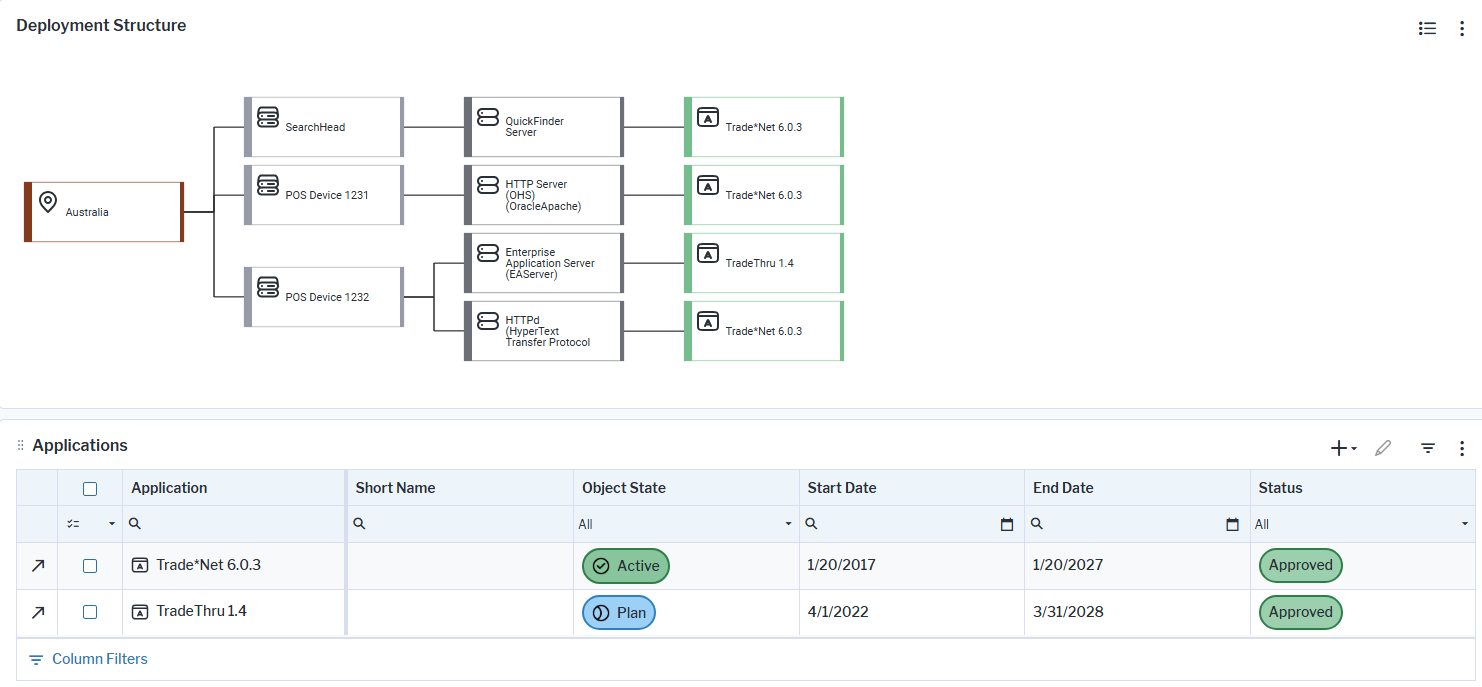
  4. Go to the Deployment Structure view. The view shows the selected location on the left. To the right of the location are the physical servers, virtual servers, and the applications they host.
  5. To review details about the IT assets in the deployment structure, select any physical server, virtual server, or application and click the Navigate navigate button to open its content area.

Alfabet Resources

  • Support
  • Learning Portal
  • Downloads
  • Announcements
  • Release Lifecycle
  • Cloud Availability

Support

  • Alfabet Help
  • Hopex Help
  • Horizzon Help
  • Unify Help
  • Knowledge Base

Resources

  • Bizzdesign Community
  • Courses and E-learning
  • Blog Articles
  • Events & Webinars
  • Resource Center

Company

  • Bizzdesign
  • Alfabet Support Policy
  • Hopex Support Policy
  • Privacy Policy
  • Code of Ethics
  • Legal Notices

Copyright © Bizzdesign