
Document the application and information portfolio
Establish a structured and reliable application portfolio to support an effective APM practice. Capture detailed information about every application in use to ensure strategic decisions are based on accurate, comprehensive data. Document each application's lifecycle, define its stakeholders, and evaluate its performance using preconfigured indicators to identify optimization opportunities and reduce risk.
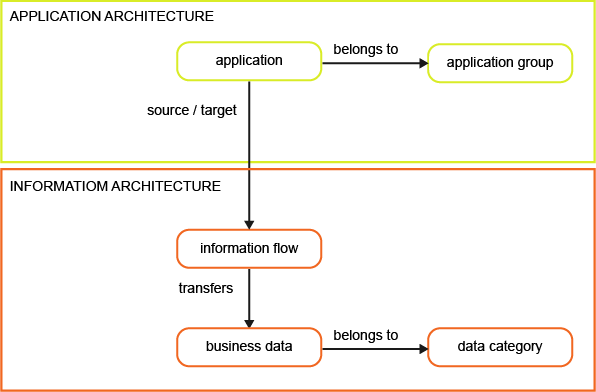
Describe the information context of your application portfolio by capturing the relationships between applications and the data they exchange. Documenting information flows allows you to trace how information is used across the enterprise and uncover redundancies. Structure your portfolio by creating application groups and assigning applications to them for targeted analysis.
|
Capture information about your applications. All applications should be documented to ensure that the application portfolio is reliable to make good strategic decisions. Define the application stakeholders, the lifecycle of each application, and evaluate the applications based on preconfigured indicators. |

|
Capture information about the application's relevance for the business. Document which business capabilities the applications provide, which business processes the applications support, etc. |

|
Add application groups to the repository. Assign applications to the application groups for portfolio analysis. |

|
Describe the information context of the application portfolio. Document the information flows between applications and the business objects that the information flows transfer. |
Alfabet supports two use cases to manage the exchange of data. . The use cases Basic Data Management and Advanced Data Management are mutually exclusive and only one may be enabled. The use case Basic Data Management is available per default. The Advanced Data Management use case must be enabled by your solution designer.
With the Basic Data Management use case, Business Object Categories and Business Objects data workbenches can be accessed via the navigation pane. The transfer of data by information flows is captured via business objects, which are at the leaf level of the business object category > business object hierarchy. Data attributes and CRUD (Create, Read, Update, Delete) operations are captured for the business object.
The use case Advanced Data Management focuses on business data as the key asset to understand where data is stored, how it is transferred, and how it is used so that your company can ensure compliance with data protection regulations and enforce data governance policies. Business data are concrete, logical instances of business objects, which represent an abstract entity such as a customer or employee. For example, the high-level business object Employee might have two different business data Employee HR and Employee Reporting.
The Advanced Data Management use case adds the class Business Data to the leaf level of the hierarchy Business Object Category > Business Object > Business Data. Please note the following:
- Business Object Categories, Business Objects. and Business Data data workbenches can be acceess via the navigation panel.
- Business data can be captured in the Business Data data workbench where it can be assigned to a parent business object and its data protection requirements specified. The business data content area provides views to capture evaluations such as the DPIA rating, the attributes of the business data, and CRUD usage.
- Data usage and CRUD (Create, Read, Update, Delete) operations are maintained directly on the business data.
- A Business Data data workbench is available in the business object content area and a Business Data Governance view shows all business data associated with the business object, the compliance of the data, and analysis of its attributes.
- A Transferred Business Data view is available in the information flow content area where transferred data can be captured from the perspective of the incoming or outgoing information flow.
- Business data is shown in the business questions Where do we use sensitive data? and Where is our data processed?