
The license package Strategic Portfolio Management is required and the use case Strategy Validation must be activated to work with the classes Vision, Goal, Objective, and Strategic Theme and the business question What is our strategic progress?
The aim of the Strategy Validation use case is to close the gaps between abstract strategic intentions and the day-to-day activities that are relevant to the enterprise architecture. Alfabet interlaces your company's strategic intentions with the enterprise architecture and supports users to consider the architecture elements that are affected by each strategic intention. The Strategy Validation use case supports:
- A standardized process for the definition and analysis of the company's vision and its strategic intentions.
- Linkage of the strategy to the IT architecture to understand which assets are impacted by which strategic intention.
- Performance KPIs to assess the current and target achievement of actionable objectives.
- Computation and analysis of all levels of the strategy to measure their potential contribution to achieving the corporate vision.
Alfabet provides a strategy framework that lets you articulate your enterprise's strategy by breaking your company's long-term vision into detailed, supporting strategic themes that can be realized via projects. The strategic framework begins with the high-level vision that defines its long-term aspiration and desired future state of the organization. It is a broad and inspirational statement that guides the overall direction and serves as a guiding beacon for all strategic efforts. An enterprise may have multiple visions that set the ultimate direction and inspiration for the organization.
Visions have goals that articulate the broad primary outcomes that the organization aims to achieve to fulfill its vision, which in turn have objectives that describe the specific measurable steps that need to be taken to achieve the goals. At the most granular level of the strategy network are strategic themes that describe the overarching areas of focus that align with the vision and goals. Your enterprise can specify multiple visions and reuse the goals, objectives and strategic themes for more than one vision.
The assets that are impacted by a strategic theme make up its architectural scope. You can specify any application, business capability, business process, component, information flow, organization, or project that is impacted by the strategic theme. Be sure to identify which business capabilities are impacted by a strategic theme, which business processes are influenced, and which applications are affected that provide IT support to the business. The strategic theme's affected architecture is inherited by its objectives, goals, and visions. Demands can be articulated to fulfill strategic needs and projects can then be created to realize the strategic themes.
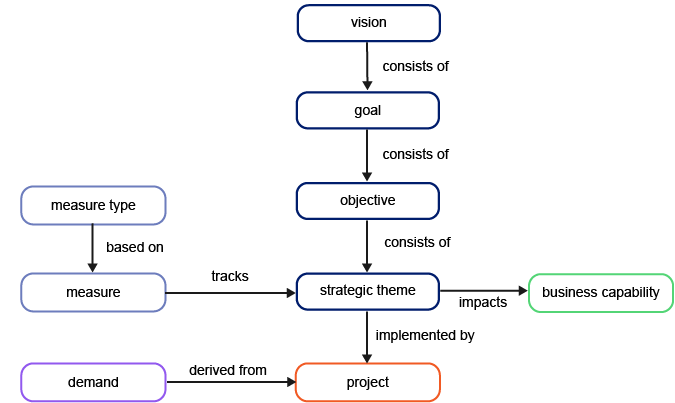
- A vision describes the long-term aspiration or desired future state of the organization. Example: 'Be the global sustainable energy provider.'
- A goal describes the broad primary outcomes that the organization aims to achieve to fulfill its vision. Example: 'Provide outstanding customer experience'
- A objective describes the specific measurable steps that need to be taken to achieve the goals. Example: 'Put customers in the center of interest'
- A strategic theme describes the overarching areas of focus that align with the vision and goals. They help in organizing and prioritizing projects and resources. Examples: 'Customer-centric development and engagement strategies'