
Alfabet ’s Strategic Portfolio Management (SPM) gives your organization a complete overview of the business and IT landscape so you can make confident, future-focused decisions. Alfabet connects your company's strategic vision with its IT architecture so that the high-level business direction is linked with the technical foundation needed to deliver it. The SPM capabilities take into consideration your organzation's many applications, technologies, projects, and strategic initiatives to provide you with a holistic view that shows how everything connects.
A core objective of Alfabet's SPM capabilities is to ensure that IT investments directly reinforce your company’s overall strategy. Once high-level strategic intentions are defined, planners can break them down into a network of interconnected, increasingly detailed strategic goals. This refinement process highlights the areas of the enterprise that require change and reveals the projects or initiatives needed to realize the corporate strategy.
SPM makes it clear which programs and projects best support the organization’s vision and priorities, guiding decision-makers toward the efforts that matter most. With real-time insight into your IT architecture, you can determine which business demands to pursue and avoid spreading resources across disconnected or low-value projects. Leaders gain a unified view of all initiatives, enabling smarter prioritization and more informed trade-offs so that time, budget, and talent flow to the initiatives that create the greatest impact.
A comprehensive understanding of the IT landscape also reduces risk. You can identify dependencies early, prevent unexpected issues, and improve investment outcomes. This clarity makes it easier to prioritize what to invest in, what to retire, what to modernize, and how each change will affect the broader organization. In a rapidly evolving business environment, tight alignment between vision, goals, and execution becomes a strategic advantage and keeps the company focused, adaptable, and consistently moving toward its desired future. By unifying strategy, architecture, and portfolio management in a single platform, Alfabet delivers the transparency and control needed to drive long-term, sustainable transformation.
Alfabet provides an Out-of-the-box Demand to Budget workflow that supports the user community in the creating transparent and consistent data in the demand-to-project process.
Where to begin: Understand the use cases
The following is an orientation to the use cases available with the license Strategic Portfolio Management. The use cases enable you to capture your data in the Alfabet repository and analyze your data in various business questions and other analytics.
 |
Strategy Validation: Define your IT strategy by capturing the strategy network made up of visions, goals, objectives and strategic themes. Articulate your enterprise's strategy by breaking your company's long-term vision into detailed, supporting strategic themes that can be realized via projects. Assess how the strategy is progressing. |
 |
Demand Management: Capture and manage demands that articulate the business needs for IT transformation. Understand the demand pipeline and which demands are to be realized in projects. Assign demand responsibility to avoid implementation conflicts and identify duplication early. Bundle demands in demand groups and evaluate the demand catalog to understand which demands might contribute to a single project or if one demand initiates a project. |
 |
Project Portfolio Governance: Document and manage your transformation projects including project responsibilities, the work breakdown in work packages and tasks, the architecture that the project impacts, project costs, and dependencies between projects. |
 |
Resource Management: Manage project resources and understand where potential resource constraints may exist. Carry out high-level planning of skills and resources required to realize a project. Manage the skill and resource requests made by organizations and projects to ensure that resource constraints won't impact a project. |
 |
Investment Optimization: Prioritize projects to optimize investment. Bundle projects in project buckets to analyze KPIs. Prioritize the current project bucket based on predefined criteria like architectural impact, business value and project risk |
Understand the classes and relationships in Strategic Portfolio Management
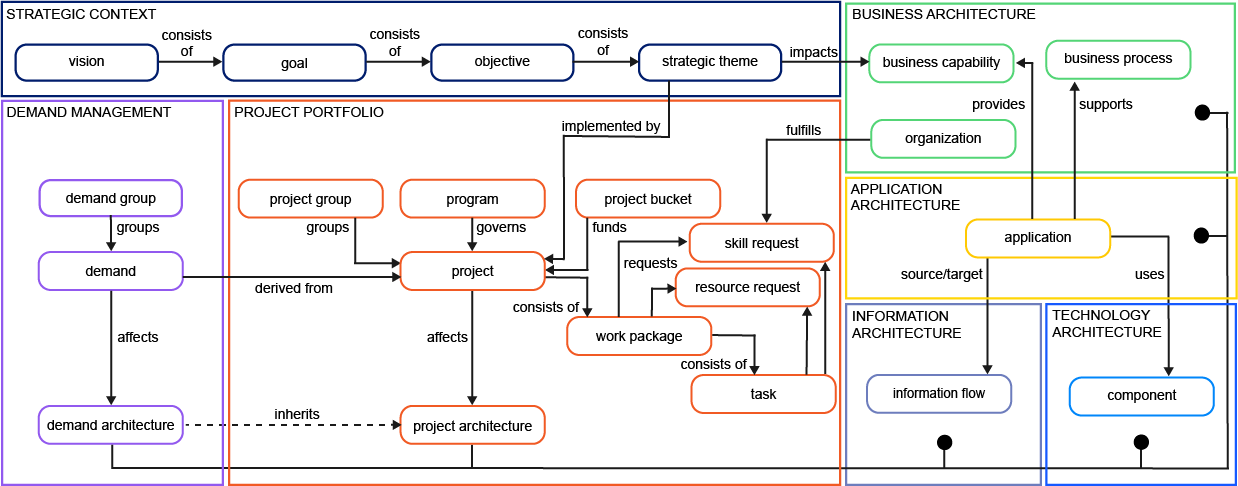
- A demand is a request for change in the enterprise’s IT landscape. Demands in Alfabet are typically strategic or impact the IT landscape. Consolidate Customer Relationship Management
- A demand group bundles demands in order to evaluate various aspects of the demand portfolio and understand which demands are important for the business. Example: Customer Management
- A project describes an activity that is focused on achieving a specified goal in the IT landscape an typically has specific project deliverables. Example: CRM Consolidation Project
- A program is a collection of related projects that together form a package of work to achieve a common objective. Example: Streamline CRM Applications
- A work package describes a clearly defined chunk of work within a project’s Work Breakdown Structure (WBS). It represents a deliverable or a set of related tasks that together produce a measurable outcome. Example: CRM Product Execution
- A task describes the work to be done for the work package. Example: CRM Development
- A resource request describes the organization requested as a resource to work on a project, work package, or task. Example: Line IT Organization
- A skill request describes the skill requested to work on a project, work package, or task. Organizations offer the skills that can be requested. Example: Junior Professional for CRM Backend Development
- A project bucket is a container for projects that supports budgeting and project prioritization. Example: APAC Customer Management
- A vision describes the long-term aspiration or desired future state of the organization. Example: 'Be the global sustainable energy provider.'
- A goal describes the broad primary outcomes that the organization aims to achieve to fulfill its vision. Example: 'Provide outstanding customer experience'
- A objective describes the specific measurable steps that need to be taken to achieve the goals. Example: 'Put customers in the center of interest'
- A strategic theme describes the overarching areas of focus that align with the vision and goals. They help in organizing and prioritizing projects and resources. Examples: 'Customer-centric development and engagement strategies'
Prerequisites
The license package Strategic Portfolio Management is required to work with the following use cases, classes, and business questions:
- The use case Strategy Validation must be activated to work with the classes Vision, Goal, Objective, and Strategic Theme and the business question What is our strategic progress?.
- The use case Demand Management must be activated to work with the classes Demand and Demand Group and the business questions What is our demand pipeline? and Which demands should be realized?
- The use case Project Portfolio Governance must be activated to work with the classes Program, Project, Work Package, and Task and the business question What is our investment landscape?
- The use case Resource Management must be activated to work with the classes Resource, Resource Request, Skill, Skill Offer, Timesheet and the business question Where can we expect resource restraints?
- The use case Investment Optimization must be activated to work with the class Project Bucket.